


Solar thermal can be worth it if your household uses a fair amount of hot water, you have a suitable roof facing roughly south, east or west, and you already have (or are fitting) a hot water cylinder. The panels use the sun to heat water directly, and can provide a good share of your hot water in summer, with a smaller contribution in winter. Your boiler or immersion heater tops it up the rest of the time.
It’s less worthwhile if you have a combi boiler and no space for a cylinder, a heavily shaded roof, or low hot water use. Our solar thermal page explains the systems we install.
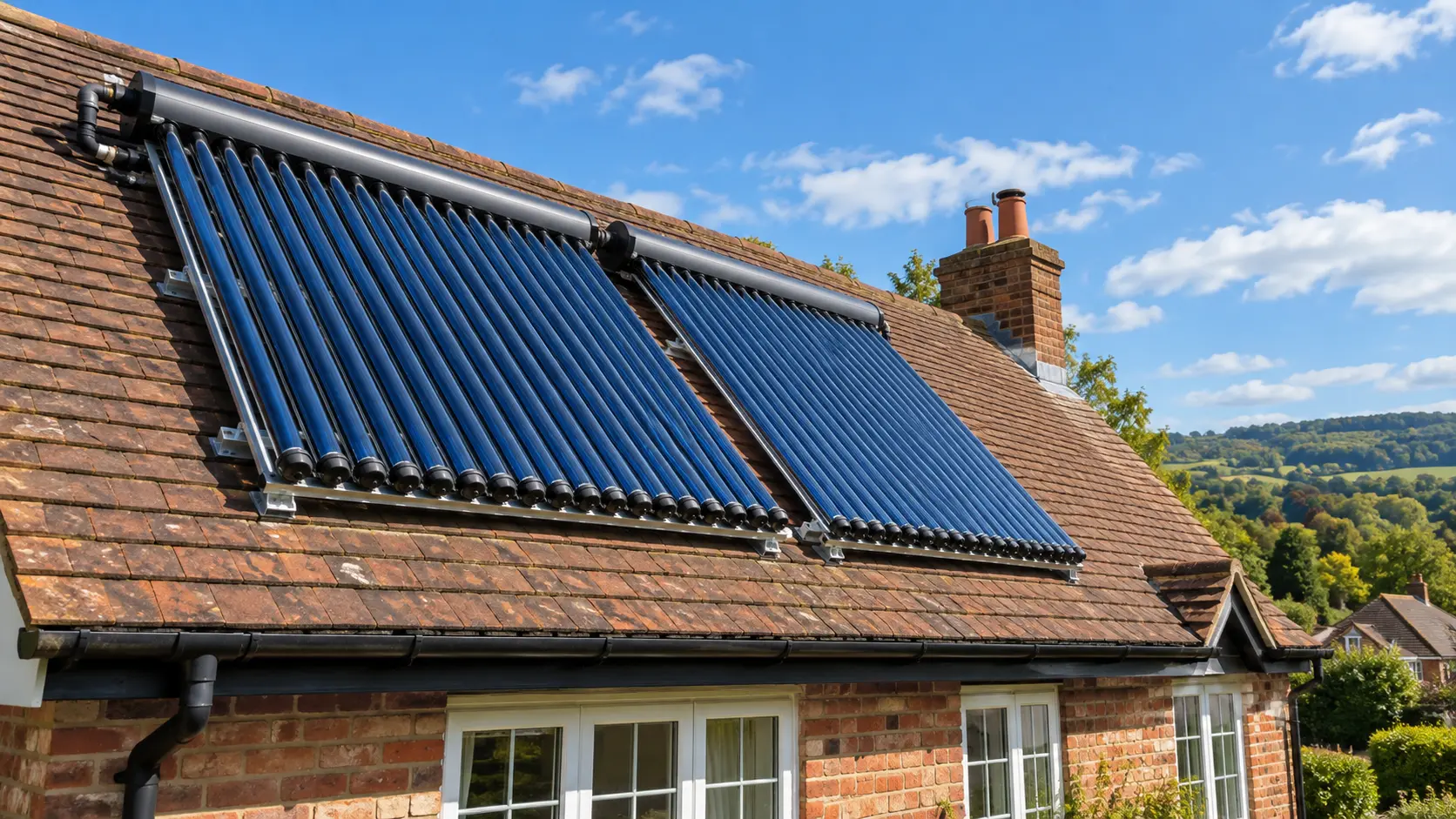
How solar thermal works
- Panels (flat plate or evacuated tube) on the roof absorb the sun’s heat
- A fluid circulates through the panels, picking up that heat
- The fluid passes through a coil in your hot water cylinder, heating the water
- When the sun isn’t strong enough, your boiler or immersion heater tops up the temperature
Most systems use a twin coil cylinder: one coil for solar, one for the boiler.
What it can realistically provide
Output depends on:
- Roof orientation and pitch
- Shading from trees and buildings
- Panel type and size
- Cylinder size
- How much hot water you use
In the UK, solar thermal typically contributes most in spring and summer. It won’t provide all your hot water year-round, so it works alongside your boiler rather than replacing it.
Solar thermal vs solar PV
| Solar thermal | Solar PV | |
| Produces | Hot water | Electricity |
| Needs a cylinder | Yes | No (unless using a diverter) |
| Works with a combi | Usually no | Yes |
| Uses | Hot water only | Anything electrical, and can heat water via a diverter |
Many homeowners now compare solar thermal with solar PV plus a diverter to an immersion heater. The best choice depends on your system and how you use energy.
Which homes suit solar thermal
- Homes with a system or regular boiler and a hot water cylinder
- Higher hot water use, such as larger families
- A suitable unshaded roof
- Homes pairing it with a heat pump or boiler upgrade
Maintenance
Solar thermal systems need periodic checks of the fluid, pressure, pump and controls. Ask your installer what the manufacturer recommends.
Solar thermal in Berkshire
Many family homes around Reading, Wokingham, Woodley and Newbury have south-facing roofs and cylinders, making them reasonable candidates. If you’re planning a new boiler or heat pump, it’s a good time to consider adding solar, as the cylinder can be chosen to suit both.
Our central heating page covers the rest of the system.
Frequently asked questions
Does solar thermal work in winter?
Yes, but output is much lower. On bright winter days it can still preheat water, reducing how much the boiler needs to do.
Can I add solar thermal to a combi boiler?
Not usually, as combis don’t use a cylinder. Some specialist setups exist, but a system boiler with a cylinder is the usual pairing.
Do I need planning permission?
Most domestic solar panels are permitted development, but conditions apply, and listed buildings or conservation areas may need permission.
Thinking about solar hot water?
Give us a call on 0800 334 5658 or drop us a message and we’ll take a look at your roof and cylinder and tell you whether it’s worth doing.